The Road Less Traveled
Most travelers follow a predictable, digitized script. They book a flight to an "obvious" destination, fight through a sea of tourists for a generic photo, and settle for overpriced meals. While there is comfort in the popular path, our American landscape is dotted with blank spaces on the mental map—towns that possess a stubborn sense of self, "morally freighted" histories, and jaw-dropping landscapes. As a narrative cartographer, I am drawn to the places that refused to be paved over, the ones that remain "stubbornly themselves" despite the pressure to modernize. These are the locations where the story isn’t found in a brochure, but in the very soil and stone.
1. Marfa, TX: Where Minimalist Art Meets Desert Mysteries
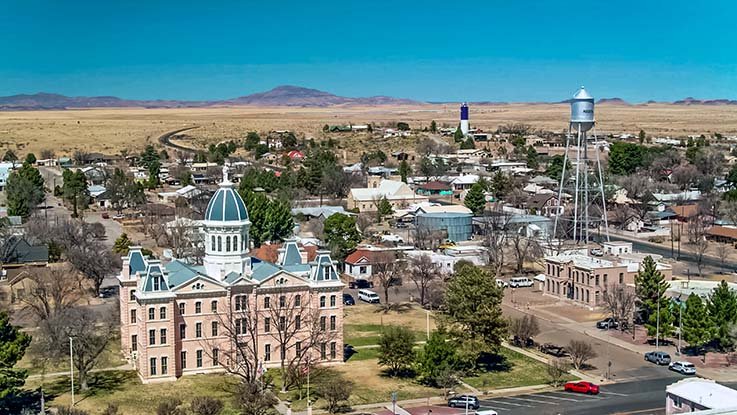
To find Marfa, you must recalibrate your internal compass to the high Chihuahuan Desert Plateau, 4,700 feet above sea level and roughly 200 miles from any recognizable metropolitan hub. This town of 1,700 people is a study in counter-intuitive survival. In the 1950s, it was the cinematic backdrop for the film Giant , starring Elizabeth Taylor and James Dean; you can still stay at the Paisano Hotel where the cast resided. However, Marfa’s modern soul was forged in the 1970s when minimalist artist Donald Judd arrived, drawn by the profound emptiness of the landscape. Judd established the Chinati Foundation, converting military buildings into permanent homes for large-scale art. Today, Marfa boasts more art galleries per capita than most major American cities. Yet, there is a mystery here that no curator installed: the Marfa Lights. Reported since the 1880s, these mysterious orbs hover over the desert near the Chinati Mountains, defying definitive scientific explanation. Visitors are often overwhelmed by the atmospheric silence and a sky so vast it feels intimate.
"The stars at night are almost rude in how bright they are."

2. Sitka, AK: The Hidden Russian Capital of the Pacific
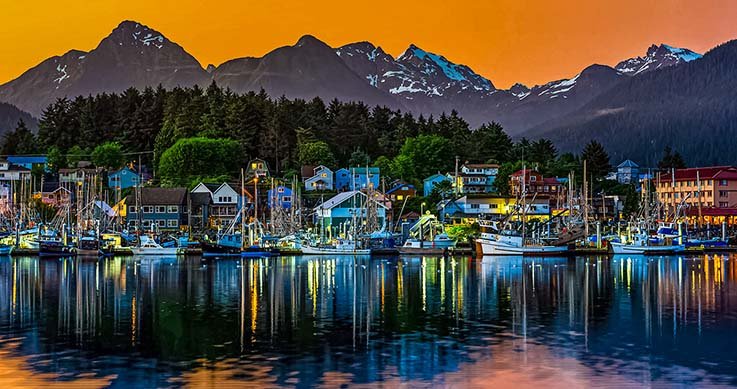
Shifting the coordinates from the high desert to the island isolation of the Pacific Northwest, we find Sitka. Only accessible by boat or plane, Sitka sits on Baranof Island, surrounded by a landscape so dramatic that one feels the word "beautiful" was invented specifically for this terrain. Here, bald eagles sit in the trees "like they own the place," overlooking a town that served as the capital of Russian America (then called New Archangel) from 1804 until the 1867 transfer to the United States. Sitka is a masterclass in layered history. In the center of town, the Russian Orthodox Cathedral of St. Michael houses priceless icons, a remnant of colonial power. But the story goes deeper: the Tlingit people have called this region home for millennia. Sitka National Historical Park preserves the site of the 1804 battle between Tlingit and Russian forces, a small park that carries enormous historical weight. It is a place where colonial ghosts and indigenous resilience coexist beneath the shadows of old-growth Sitka spruce.
3. Bisbee, AZ: The Town Where Roads are Optional
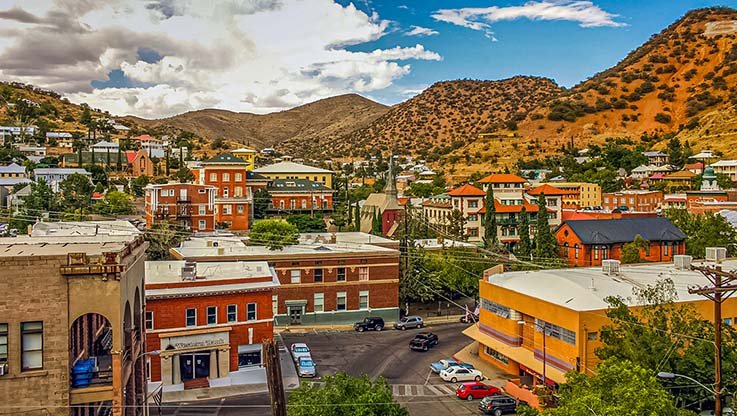
Recalibrating back to the southern borderlands, we find Bisbee tucked into the Mule Mountains. Once one of the richest mining towns in the world, Bisbee’s Copper Queen mine pulled over 8 billion pounds of copper from the earth. The town’s geography defies logic; Victorian-era homes cling to steep canyon walls, connected by a network of winding staircases that serve as the only access to neighborhoods unreachable by car. The town’s fate pivoted in the 1970s when artists and counterculture seekers moved in, attracted by the "old mining town grit" and cheap rents. This bohemian energy now defines the streets, yet the industrial scars remain artistic. The Lavender Pit, a massive open-pit mine, has oxidized over decades into a surreal palette of vibrant blues and purples. Bisbee is a town that could not be faked if you tried—a place where the past is literally etched into the canyon walls.
4. Eureka Springs, AR: A Victorian Spiral in the Ozarks
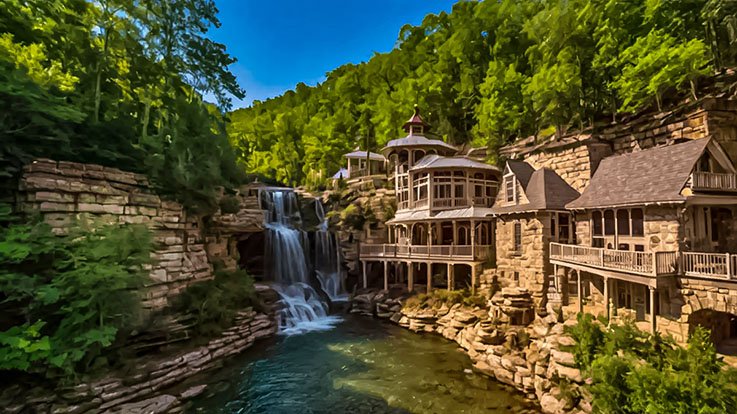
In the Ozark Mountains, the terrain dictates the architecture. Eureka Springs was founded in 1879 around "healing springs"—of which there are over 63—and it grew so rapidly that it was built without traditional planning. Because it sits in steep hollows with "no flat land anywhere," the town is a vertical marvel. Some buildings feature front and back doors on entirely different floors, and the 1890s Victorian street-scape is remarkably preserved because the town never had the space to tear anything down for modernization. Beyond its winding, spiral streets, Eureka Springs is a social outlier—a progressive LGBTQ+ haven in the heart of the South. It is also home to the "haunted" Crescent Hotel, a 1886 structure with a dark history as a fraudulent cancer hospital run by con artist Norman Baker. Whether you are there for the history, the haunts, or the healing waters, Eureka Springs is a town that refuses to sit on a level plane.
5. Jerome, AZ: The Ghost Town That Literally Slid Away
Perched on Cleopatra Hill, Jerome is known as the "largest ghost town in America." Once a copper hub dubbed the "wickedest town in the West" with 15,000 residents, its population crashed to fewer than 100 after the mines closed in 1953. The town is a testament to physical instability; honeycombed with mine tunnels, the ground beneath Jerome is constantly shifting. This instability led to Jerome’s most surreal quirk: the concrete town jail literally slid 225 feet downhill from its original site. Today, the town has reinvented itself as an arts colony, with galleries housed in brick and wood structures that look as if they might "slide off the mountain at any moment." To ground yourself in the history of the slide, one can visit the Douglas Mansion, a 1916 estate that is now a state park overlooking the Verde Valley.
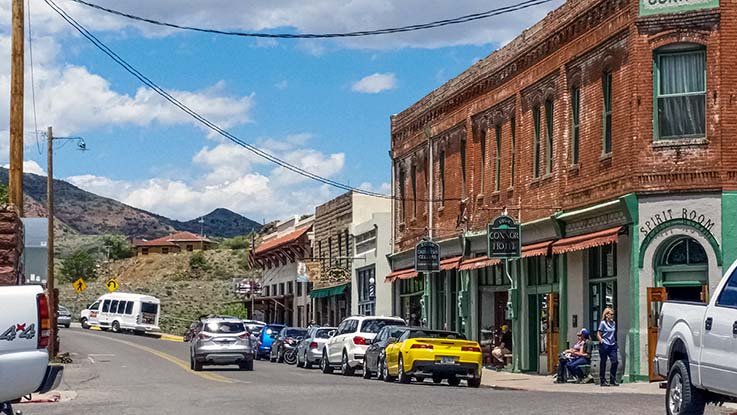
6. Taos, NM: The Triple-Layered Soul of the High Desert
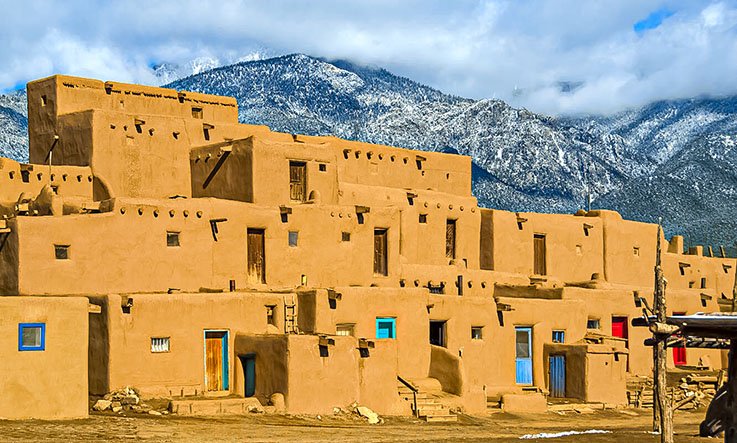
In Taos, history is not a line, but a series of layers folded on top of each other. The foundation is the Taos Pueblo, a multi-story adobe structure continuously inhabited for over 1,000 years. It is a UNESCO World Heritage site and, crucially, it is not a museum—it is a living community. The second layer is Spanish colonial history, embodied by the San Francisco de Asis Church, an adobe landmark that has captivated photographers like Ansel Adams for a century. The third layer, the arts colony, began with a narrative hook: a wagon wheel break in 1898 that forced two painters to stop and stay. They were captivated by the "extraordinary light" of the high desert, a force that unifies all three cultures.
"The greatest experience from the outside world I have ever had." — DH Lawrence on Taos
7. Telluride, CO: The End of the Road
Telluride is literally at the end of the road. Highway 145 terminates in a box canyon at 8,750 feet, surrounded on three sides by 13,000-foot peaks. There is no way through; you arrive, and then you turn around. Founded as a mining camp in 1878, it was the site of Butch Cassidy’s first bank robbery in 1889. When the mines closed, the town transitioned into a prestigious hub for film and bluegrass festivals. The town’s commitment to its unique geography is seen in the free gondola—the only one of its kind in North America—connecting the historic downtown to Mountain Village. Sitting in that box canyon, the scale of the Victorian storefronts against the massive San Juan Mountains creates a contrast that feels almost absurd. As longtime resident and writer Jeff Lech observed, the location possesses a quality that transcends simple tourism.
"The town has a quality of light and air unlike anywhere else; it changes you a little whether you want it to or not." — Jeff Lech

8. Port Townsend, WA: The Victorian Seaport at the Edge of the Salish Sea
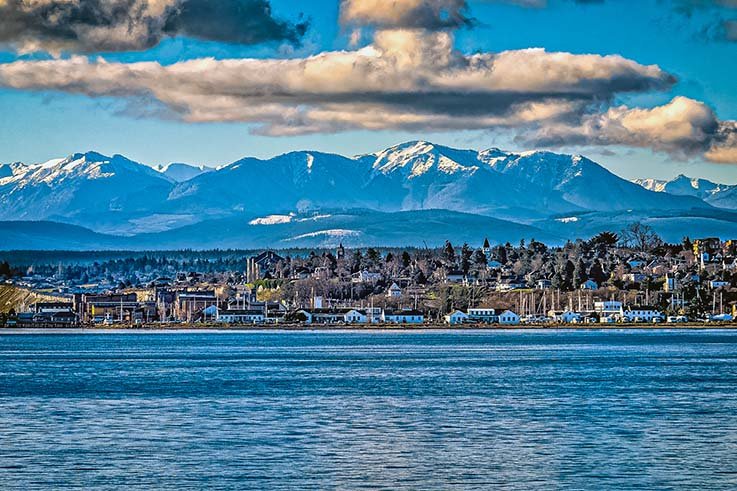
Port Townsend occupies one of the most dramatic settings in the Pacific Northwest: perched at the northeastern tip of the Olympic Peninsula, it looks outward to the Salish Sea and inward to a remarkably intact nineteenth-century street-scape. In the 1880s, boosters imagined it would become the “New York of the West,” a grand Pacific port commanding maritime trade. That future never fully arrived, but the failed ambition became its gift to the present. Because the expected railroad connection bypassed the town, much of its ornate brick and wood Victorian architecture was never demolished for the sake of progress. What remains is one of the finest collections of historic commercial buildings on the West Coast.
Yet Port Townsend is more than a preserved façade. It is a working maritime town with boatyards, ferries, sea captains, artists, writers, and weather-beaten dreamers who all seem to belong to the same windswept story. The town’s relationship with the water defines everything: the smell of salt in the air, the sight of wooden schooners in the harbor, and the long, gray-blue horizon stretching toward Whidbey Island and beyond. Fort Worden, once a coastal military installation, now serves as a cultural campus where bunkers, beaches, and parade grounds coexist with festivals, workshops, and creative retreats. Port Townsend feels like a place built on a beautiful delay—one that allowed history, sea light, and eccentricity to harden into character.
“It feels like a town standing at the edge of the continent, listening for ships that may still come.”
9. Bend, OR: High Desert Reinvention Beneath the Cascades
Bend sits where Oregon’s landscapes collide in spectacular fashion: ponderosa forest gives way to volcanic terrain, sagebrush opens toward the high desert, and the snowy summits of the Cascade Range rise almost theatrically to the west. What makes Bend so striking is not only its scenery, but the way it has repeatedly reinvented itself in response to that setting. It began as a remote logging town along the Deschutes River, a place of timber mills and frontier practicality. Over time, as the old industrial economy faded, Bend transformed into one of the West’s most compelling outdoor cities—part mountain gateway, part craft-culture hub, part polished but still rugged high-country town.
The surrounding geography gives Bend an almost unfair abundance of natural drama. Mount Bachelor looms nearby; ancient lava fields and cinder cones scar the region; the Deschutes threads directly through town, providing a ribbon of water and recreation through an otherwise dry landscape. Unlike many places that market themselves through scenery alone, Bend has learned how to inhabit its landscape actively. Residents and visitors move through it by hiking, skiing, mountain biking, paddling, climbing, and floating, as though the town’s identity is inseparable from motion. And yet Bend also retains a strong sense of western ease: a walkable downtown, old brick buildings, lively cafés, and a riverfront that softens what could otherwise feel like a severe environment. It is a place where the frontier was not erased, merely updated.
“Bend feels like the American West after it learned how to brew good coffee and keep its mountains close.”

10. Kennebunkport, ME: Where the Working Coast Still Meets Elegance
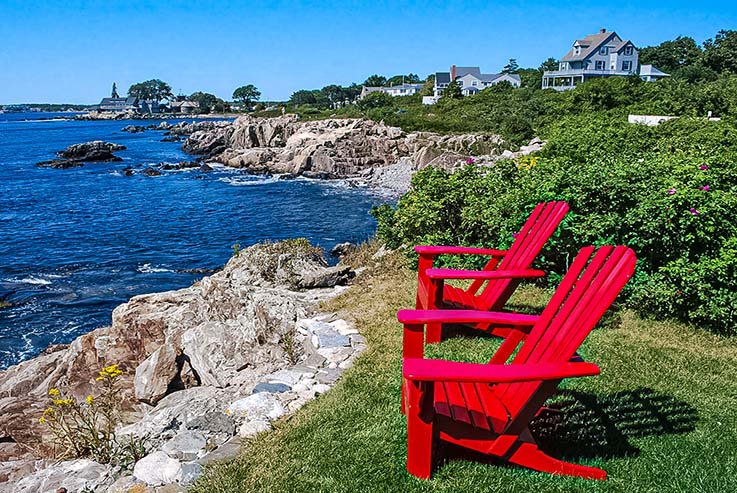
Kennebunkport sits on the southern Maine coast with an assurance that feels earned rather than manufactured. Long before it became associated with summer visitors and presidential compounds, it was a shipbuilding and fishing community shaped by the hard logic of tides, weather, and Atlantic commerce. That older identity still lingers beneath the polished storefronts and manicured inns. The village is divided between two complementary worlds: Dock Square, with its walkable cluster of shops, galleries, and historic buildings, and the coast beyond, where the ocean asserts itself with granite ledges, salt air, and restless surf. This tension between refinement and ruggedness is exactly what gives Kennebunkport its unusual magnetism.
Its beauty is not dramatic in the western sense, but textured, intimate, and deeply New England. White church spires rise above tree-lined streets. Historic captains’ homes recall an era when maritime wealth built the town’s most elegant architecture. At nearby Cape Porpoise, lobster boats still work the water, reminding visitors that this is not merely a stage set for vacationers. Then there is Walker’s Point, where the Bush family compound made the town nationally recognizable, though even that association fits into a larger local pattern: Kennebunkport has long attracted those who value privacy, beauty, and a certain understated coastal dignity. What distinguishes it from more generic seaside resorts is that the working Maine coast still breathes beneath the postcard surface. The town has polish, yes—but also weather, memory, and salt.
“Kennebunkport is what happens when a fishing village puts on its best linen jacket but never forgets the smell of the harbor.”
Conclusion: Where America Still Feels Like Itself
What unites these extraordinary towns is not simply their beauty, though each possesses that in abundance. It is their uncommon ability to hold onto something essential: a landscape, a history, an architectural identity, a cultural memory, or a way of life that has not been flattened into sameness. In an age when so many destinations feel curated for algorithms and crowds, these places remain gloriously specific. They are not interchangeable. They could not be picked up and dropped somewhere else without losing the very thing that makes them matter.
Some cling to canyon walls or mountain slopes. Others face the sea, the desert, or a high, luminous plain. Some were shaped by mining booms, some by maritime trade, some by Indigenous heritage, art colonies, railroad detours, or sheer geographic stubbornness. But all of them remind us that the richest travel experiences are often found in places that never surrendered their soul for convenience. They still ask something of the traveler: attention, curiosity, and a willingness to step off the obvious path.
To visit towns like these is to encounter the American story in a more intimate form—not as a slogan or postcard, but as something layered, weathered, and still very much alive. These are the places where the past has texture, where the setting still shapes the identity, and where beauty is inseparable from character. In the end, perhaps that is what makes a place unforgettable: not that it tries to impress everyone, but that it remains fully and unapologetically itself.

 Back to American Podcasts